US attacks on Venezuela explained

What happened?
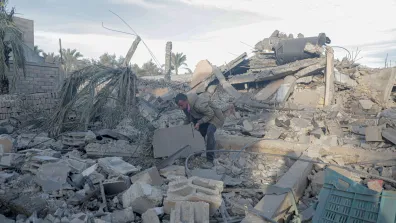
In early January 2026, following months of military build-up in the Caribbean, the United States launched a military attack on Venezuela. The US abducted President Nicolás Maduro and First Lady Cilia Flores and transported them to the US on alleged drug-trafficking charges, some of which have since been dropped.
Is the US attack on Venezuela illegal?
International law is clear: this is illegal.
The UN Charter states that no country can attack or ‘use force’ against another country. The only clear exception to this prohibition is in cases of self-defence, and only “if an armed attack occurs”. Venezuela has not attacked the US, and there is no credible evidence of an imminent threat that could justify the use of force.
The UN Security Council, in an emergency meeting, condemned the US for the crime of aggression.
Why did the US attack Venezuela? The US position
In the months before the attack, the US claimed, with very little evidence, that Venezuela is an important part of the regional drugs trade. The US then started attacking boats and their crews in the Caribbean which it claimed were transporting drugs.
But just a few hours after attacking Venezuela, US President Donald Trump abandoned the idea that this attack was to stop drugs from entering the US.
Trump stated openly that “we will run Venezuela”. On 5 January, the US State Department posted a blunt message on social media: “This is our hemisphere.”
Why did this really happen?
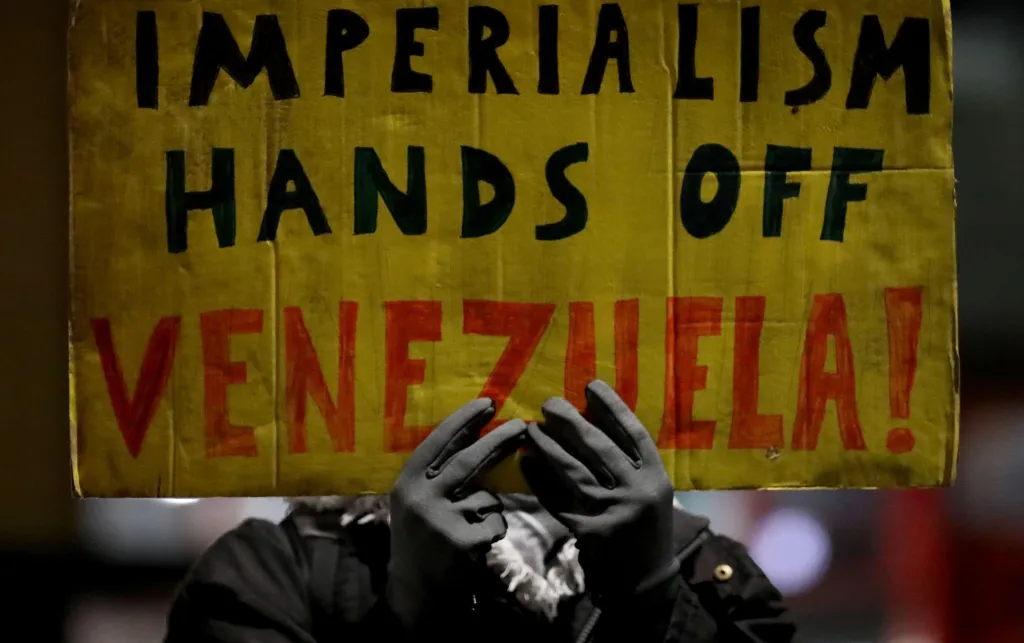
US imperialism continued
This attack is not a one-off, but the latest moment of a long history of imperialism. For centuries, powerful Global North countries like the UK and the US have colonised Global South countries – taken control and stolen their resources, land and people for their own gain.
The US has intervened in other countries in Central and South America for over 200 years. In 1823 US President James Monroe created the ‘Monroe Doctrine’ which declared the Western Hemisphere was under the US sphere of influence.
Since then, the US has been involved in repeated coups, economic coercion, and military occupations throughout Latin America and the Caribbean, often secretly influencing governments and supporting dictatorships. Many countries in the region still remember how the US treated them like US colonies, rather than the independent countries which they are.
The US National Security Strategy, published in November 2025, explicitly revives a modernised ‘Monroe Doctrine’ arguing that the US can control and influence Central and South America and treat them as their own “backyard”. This is a clear continuation of US imperialism in the region.
The US is stealing Venezuela’s oil and minerals
Venezuela holds the world’s largest oil reserves, alongside significant deposits of gold and other “critical minerals” – raw materials like lithium and nickel that are essential for renewable energy and technology like solar panels and electric vehicles. For decades, this wealth has attracted the attention of external powers which want control over energy supplies.
Following the attack, the US government announced plans to take control of Venezuelan oil production and sales, claiming this would benefit the Venezuelan people. Yet the reality tells a different story.
President Trump informed major US oil corporations about the attack before the US government (Congress) was briefed. As a result, share prices of the oil corporations surged on the expectation of increased access to Venezuelan oil. The economic incentives behind the US attack of Venezuela are clear – this obviously wasn’t just an issue of “national security” or counter-narcotics action.
Article: Reclaiming power in a broken energy system
Learn more about the UK's scramble for 'critical minerals'.
Read the articleThe US is trying to disrupt China’s economy
The intervention in Venezuela is not only about controlling oil reserves; it is a strategic manoeuvre aimed at disrupting the influence of the US’s rivals, particularly China. For years, China has been Venezuela’s largest oil customer and a major political and trade partner of many countries in Central and South America.
The Trump administration has explicitly said that the attack on Venezuela is meant to limit Chinese investment and influence in Venezuela’s oil industry. Chinese corporations are already seeking alternative sources of oil.
Powerful Global North countries have always sought to influence the world in their own interests. Venezuela’s oil and mineral wealth is now part of a geopolitical contest; the US and its allies are more concerned with securing strategic advantage over China and other rivals than the people of Venezuela and their human rights.
Why is the US threatening Colombia, Mexico and Cuba?
The attack on Venezuela has been accompanied by threats aimed at neighbouring states such as Colombia, Mexico and Cuba. President Trump has threatened similar action in these countries, including saying that Cuba was “ready to fall” without US intervention.
This suggests a deeply troubling willingness to militarise foreign policy across the region.
The US’s imperialist strategy during the last century in Central and South America has not only focused on controlling public and natural resources, but also on ensuring that no real political alternatives to US imperialism emerge.
Salvador Allende, elected as President of Chile in 1970, aimed to transform Chile through a socialist project, seeking land reforms, nationalisation of key industries like copper, and improved social welfare for the working class. The US, through direct intervention from its Central Intelligence Agency (CIA), supported a military coup that ousted him in 1973, leading to a dictatorship under Augusto Pinochet. This is just one in a long list: the US has been directly involved in overthrowing governments and eliminating political opposition in Cuba, Venezuela, Ecuador, Argentina, Brazil, Nicaragua, Paraguay, Uruguay, Honduras and Guatemala.
What impact is the US attack on Venezuela having?
Increasing militarism
The attack comes at a time when conflict and militarisation are increasing globally.
In 2024, military spending rose as a percentage of the economy (gross domestic product) in 84 countries, amounting to approximately £1.1 trillion ($1.5 trillion).
President Trump has stated that by 2027 the US will spend $1.5 trillion on the military, which has pushed other countries to also increase their military spending. This only benefits the military and arms corporations – while harming people everywhere. Increasing military attacks mean more people dying, more stolen land and more violations of human rights.
The US has attacked nine countries in the last year, including supporting Israel’s genocide of the Palestinian people in the Gaza Strip, which has killed over 70,000 people so far.
How has the US attack impacted Venezuela?
Venezuela has been under a decade of US sanctions and a US blockade, meaning Venezuela can only trade with countries not politically aligned with the US, such as China and Russia. This, along with Maduro’s increasingly authoritarian government has left many Venezuelans facing poverty, struggling to access food and medicine. During that time over 8 million Venezuelans have been forced to leave the country.
Venezuelan society has responded in different ways to the US attack, yet many leftist voices in Venezuela are clear: while they are critical of human rights abuses and failures of Maduro’s government, have remained steadfastly anti-imperialist, opposing any external military or political interference.
Since the US attack, some political prisoners have been released, but the Venezuelan government is further repressing civil society: journalists are being arrested and civilian militias are in the streets stopping and searching people’s phones.
Civil society organisations inside Venezuela are responding to the US attack with resilience, demanding sovereignty, dignity, and an end to external interference in their country. Their voices must be amplified, not twisted to support foreign political agendas, but in solidarity with their own priorities for peace, justice, and control over their own futures.
What impact will US access to Venezuela’s resources have on the climate?
The environmental consequences are stark. Expanding the extraction of oil, a fossil fuel, in Venezuela will increase carbon emissions at a moment when the world urgently needs a rapid and just transition away from oil and gas.
Big corporations in the Global North are already extracting lithium, rare earth, and other “critical minerals” essential to renewable energy technologies from Venezuela and other Latin American countries.
This system continues patterns of colonial extraction, exploitation and environmental destruction, where Global North corporate profits and geopolitical advantage is prioritised while sacrificing Global South ecosystems, communities, and climate justice.
How have countries responded to the US attack?
Governments across Latin America and beyond have rejected the US assault on Venezuela. A joint statement from Brazil, Chile, Colombia, Mexico, Spain, and Uruguay condemned the military action as a violation of international law and a threat to regional peace and security. They reaffirmed that Venezuela’s internal problems must be resolved through dialogue, negotiation, and respect for the Venezuelan people, without external interference.
How has the UK government responded?
The UK government has been cowardly in its response, fearing that speaking out against the US attack could jeopardise its special relationship with the US, including diplomacy with the US on ending Russia’s invasion of Ukraine and the UK-US trade deals the UK views as central to its economic growth.
The UK is prioritising its alliance with the US over moral opposition to military interventions -- despite the attack undermining the very international law frameworks the UK helped to establish.
How can we stand in solidarity with Venezuelans?
Solidarity with the people of Venezuela means:
- Standing with Venezuelans and listening to their voices
- Rejecting foreign military attacks and opposing the use force to gain political control
- Rejecting imperial, colonial approaches that prioritise Global North domination and profits over the lives and rights of people in the Global South
- Defending the sovereignty of all countries
- Challenging the extraction of Global South resources for Global North profits
- Supporting international law everywhere
Most importantly, solidarity must centre the voices of Venezuelans.
The struggle for sovereignty, peace, and justice in Venezuela is inseparable from the broader fight against imperialism worldwide – and so we all have a part to play.
This article was last reviewed on 09.01.2026.
Share this page
Read next
Why are the US and Israel attacking Iran?
The Western Sahara: 50 years of Morocco’s illegal occupation