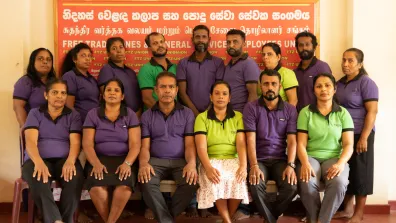
We will never stop fighting for workers' rights

At War on Want, we campaign and support partners, allies, and workers across the world to build corporate accountability, fight for human rights, workers’ rights, food sovereignty, trade justice, climate justice, and an end to militarism and occupation. These are not separate issues. Poverty, inequality, war and injustice don’t just happen. They are the result of decisions made by those who hold power – governments and corporations – and a rigged global economic system. This system generates increasing wealth and power for the already wealthy, at the expense of the majority of people on this earth.
We can change the system
All around the world workers face exploitation and discrimination, but by organising and building power through trade unions, workers are winning increased rights and decent work for millions of people.
In the UK, trade unions have given us the weekend, the eight-hour day, paid holidays, paid sick leave, paid paternal leave, and pretty much every other working right we now enjoy. Globally trade unions are fighting for the rights of those working in some of the most exploitative conditions, such as in garment industry supply chains.
The Covid-19 pandemic has further exposed and aggravated the injustices that already existed in the world of work. Big businesses, such as McDonald’s, made huge profits – cashing-in on government support programmes, and continuing to dodge taxes – whilst passing the cost of the pandemic on to their workers.
Corporations are all too keen to point to the thousands of jobs they create. However, unless they ensure that the essential rights of workers in their supply chains are protected, and that the wages they pay them are enough to live on, these jobs benefit no-one but the companies themselves.
In-work poverty – where wages are so low, working people live below the poverty line –precarious and zero-hours contract work are now commonplace, especially among migrant, female, and ethnic minority workers. Too many people are forced to work for wages that do not even provide for their basic needs, let alone for those of their families.
In 2022, more than 22% of the UK population lived in poverty – that’s 14.5 million people – and of these, 8.1 million were working age adults (JRF, 2022). That’s why we need trade unions, workers’ representation and workers’ rights enshrined in law – to protect every worker.
Over the past year strike action has been all over the headlines, as public and private sector workers in the UK have fought back against years of real term pay decreases and cuts to public services.
The UK government has responded by proposing new legislation (the Minimum Service Levels Bill) to curb our right to strike. Strike action is a last resort, but throughout history, it has been a crucial tactic for workers in securing fair pay and working conditions. From the striking workers at the Grunwick Film Processing Plant, which saw a huge movement grow to defend migrant workers, to the Dagenham sewing machine plant workers, whose brave actions led to the Equal Pay Act. We must stand together to defend our right to strike.
Collective power
Despite attacks on the right to strike across the past year, we have seen workers and trade unions win huge victories for workers, using the strength of their collective power:
-
Arriva bus drivers won an 11% pay-rise across the country after Unite members took strike action.
-
After years of campaigning, the Rail Maritime and Transport Union (RMT) won free travel for 5,800 subcontracted Transport for London cleaners, who had been denied the benefits of their directly-employed counterparts.
-
Last year Workers in Bangladesh, with the solidarity of War on Want members and UK trade unions, secured an extension of the crucial Accord for Health and Safety in the Textile and Garment Industry. This year continued campaigning led to further high street retailers becoming signatories to the historic agreement, and extension of the Accord's protection to factories in Pakistan, which guarantees legally-binding safety standards for tens of thousands of garment sector workers.
-
After months of organising, workers in Coventry took the first ever strike action against Amazon in the UK demanding better pay and conditions. They now look set to secure a recognition agreement between Amazon and the GMB union — following the successes in the US last year, when workers in New York forced Amazon to recognise a workers’ union for the first time in its history.
-
After workers raised the alarm about the toxic culture and sexual harassment in McDonalds restaurants, McDonald’s has signed a legally binding pledge with the equality watchdog.
A new way forward...
As we emerge from the grasp of the pandemic, and grapple with the climate crisis, there is a real opportunity to build a new economic system. But we cannot allow green recovery programmes in the Global North to continue to push the costs of development on to the Global South, perpetuating the inequalities built by colonialism and neoliberalism.
We must defend our rights to organise and to take strike action. We know that it is by standing together in trade unions that we can shift power back to ordinary people, place workers at the centre of a green economic recovery, with jobs that offer good pay, safe workplaces, union recognition and social protections. We must demand a truly Global Green New Deal – one that is conceived with workers and their communities at its core rather than imposed upon them.
War on Want is proud to stand with every worker throughout the world. We support all those fighting against exploitation and discrimination, and for their right to decent working conditions.

Join the struggle: become a member today!
We cannot continue our fight without your generous support – become a War on Want member today.
Share this page
Read next
Our food system is broken: we need three urgent changes to fix it

Who pays the price of extraction?