What is Investor-State Dispute Settlement (ISDS)?
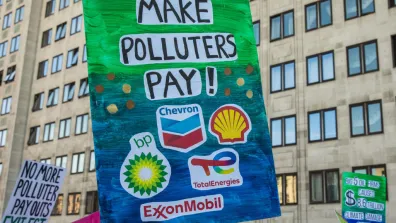
It sounds like dystopian science fiction, but this is reality. Corporations are given this power because of Investor-State Dispute Settlement (ISDS) – the fossil-fuel industry’s secret weapon. Read on to find out how ISDS works, and why it’s so problematic.

What is ISDS?
ISDS stands for Investor-State Dispute Settlement.
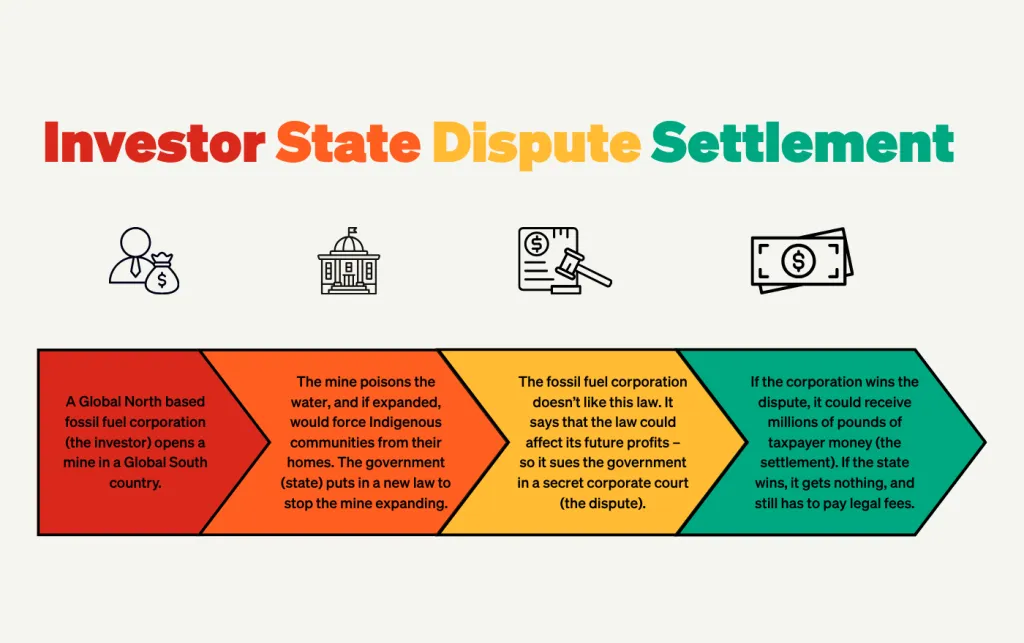
ISDS allows corporations (the investor) to sue governments (the state) for implementing policies that protect the climate or renationalise public services – which the corporations believe could negatively impact their projected future profits (the dispute).
ISDS is a clause included in trade and investment deals – which are legally-binding deals between two or more countries to facilitate trade or corporate investment between the countries.
For example, in 2015, Italy banned new oil and gas operations near the coast because they would harm the environment and local community. UK corporation Rockhopper had wanted to build an oil platform near the Italian coast – because of ISDS it was able to sue Italy and win a €190 million (£165 million) settlement.
Allowing corporations to bully governments for protecting people and the planet is deeply unjust.
How does ISDS work?
ISDS cases aren’t tried in normal courts – they happen in secretive ‘corporate courts’. These courts ignore national and international laws – such as human rights law or international environmental law.
Corporate courts only look at what a government and corporation have agreed to in the trade or investment deal.
Corporate courts give corporations their own custom-made legal system that no one else can use, and which only looks at issues from the corporations’ point of view.
As a result, corporations usually win the cases.
Who benefits from ISDS agreements?
Corporations benefit from ISDS cases – because they usually win. When they do, governments – usually in the Global South – have to pay out millions or billions of taxpayer money.
As of 2023, corporations had been awarded more than $100 billion (£75 billion) of public money – taxpayers’ money – through ISDS rulings. Even when governments win a case, they don’t receive any compensation, and have to pay the legal fees, which on average cost around £3.7 million.
Corporate courts give corporations their own custom-made legal system that no one else can use, and which only looks at issues from the corporations’ point of view.
The super-rich also benefit from ISDS.
The UK has sanctioned rich Russian corporate leader (an oligarch), Mikhail Fridman, because of his close relationship to the Russian President Vladimir Putin – whose government has launched an illegal war on Ukraine. The sanctions have frozen Fridman’s UK-based assets, barred UK corporations from doing business with him, and banned him from entering the UK. Fridman is now using ISDS to sue the UK.
What are the criticisms of ISDS?
ISDS is bad for the climate
The majority of ISDS claims are brought by fossil-fuel corporations against governments which create laws to protect the climate and ecosystems.
France’s energy minister drafted an ambitious law in 2017 aiming to end France’s fossil fuel extraction by 2040. Energy company Vermillion threatened the French government with an ISDS case, and the law was weakened as a result.
ISDS is a huge threat to preventing further climate breakdown – all governments must invest in a just transition to fairer societies built on renewable energy, well-funded public services and equality. Instead, they’re being threatened by polluting corporations.
ISDS reinforces colonial dynamics
Most ISDS cases are brought by big, rich corporations based in the Global North, against poorer governments in the Global South.
This is no surprise. Our trade system – in fact our whole global economy – is rigged in favour of the super-rich and big corporations.
The system reinforces colonial-era relationships, with Global North governments and corporations extracting resources and exploiting people in the Global South for their own profit.
ISDS ignores human rights
Corporate courts are allowed to ignore human rights, as the courts only consider what was agreed in a trade or investment deal.
Human rights are fundamental and universal – they apply to all of us no matter our race, nationality, sex, age or other status. No system should be able to deny our human rights.
ISDS is an attack on democracy
ISDS creates a two-tier legal system – a separate system for big corporations and the super-rich on one side, and one for everybody else. This isn’t democratic. Laws should apply equally to all people and businesses, including those in positions of power and wealth.
ISDS creates a system where a government is not free to make laws. Corporations can threaten governments into changing their laws, or take millions in public money if governments put in place laws that protect people and planet.
What examples are there of ISDS being used against countries?
ISDS is written into more than 3,000 international trade and investment deals.
The UK-Colombia investment deal is one of these. 12 ISDS claims have been brought against Colombia over the last decade, three of which were made by UK corporations using the UK-Colombia deal. As of 2023, pending cases against Colombia totalled £9 billion – 13% of the country’s national budget.
UK-based mining corporation Glencore owns the Cerrejón coal mine in Colombia – the largest in Latin America. Glencore forced 35 Indigenous communities from their ancestral territories and contaminated air, soil and water supplies to build the mine.
After years of campaigning by affected communities, the Colombian government blocked a proposed expansion to the mine. Glencore has launched at least four ISDS cases against Colombia – it won the first case and was awarded £14 million.
Why is ISDS added into trade deals?
One of the ways a country makes money is by foreign corporations investing in said country – for example by opening a garment factory or mine, or basing its corporate headquarters there. This creates jobs and corporate taxes paid into the public purse.
Governments want to protect this foreign investment – and protect the investments of corporations based in their own country.
Governments see ISDS as a way to protects these corporate investments – so they put it in trade deals.
However, in reality, most of the profits from foreign investment are taken by the corporate CEOs and shareholders in the Global North, not workers in their factories and mines, and not governments – who lose billions to corporate tax dodging each year.
Is ISDS in UK trade and investment deals?
Yes, ISDS is written into many of the UK’s current trade and investment deals – 84 deals as of 2024 – including with Colombia, Russia and Singapore.
While many countries are moving away from ISDS, the UK government is doubling down – it included ISDS in its latest trade strategy, published in 2025.
Under UK Prime Minister Keir Starmer, the UK has agreed new trade deals with India and the US. Alongside the UK-India trade deal, there are ongoing negotiations about a UK-India investment deal – to facilitate foreign investment between the two countries. India has moved away from ISDS in recent investment deals – but the UK is pushing for ISDS to be included.
This is a huge risk for the UK – it means that fossil fuel and other big corporations can sue the UK.
Right now, for the first time in a decade, the UK is being sued under ISDS. The UK High Court blocked a bid for a new coal mine in Cumbria in 2024 – because it would have been a climate disaster. Now, because ISDS is in the UK-Singapore trade deal, the coal corporation behind the Cumbrian mine is taking the UK government to court.
How do we end the use of ISDS?
Countries around the world, from Ecuador to Australia, are beginning to abandon ISDS.
In February 2024, the UK left the Energy Charter Treaty (ECT) – the world’s most used treaty containing ISDS clauses – because of the threat it posed to the UK’s transition away from fossil fuels. The EU withdrew from the deal a month later.
The UK and EU’s withdrawal from the ECT was significant. It was the result of years of pressure from campaigning groups, including War on Want, which helped MPs see that ISDS would stop the UK government from doing its job – making laws to protect people and the planet.
The UK knows ISDS is bad news – now it needs to commit to removing it from all current and future trade deals.

Sign up for emails
Join the list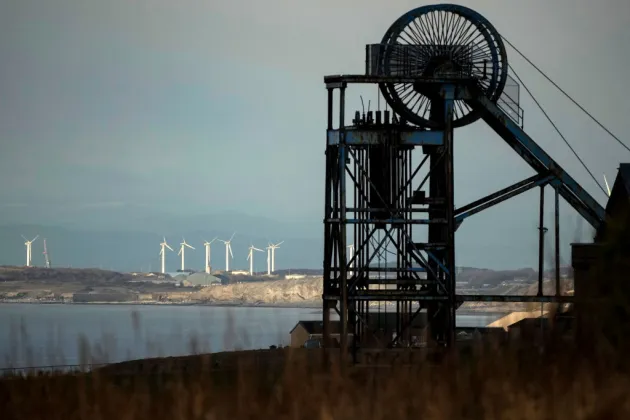
No Secret Courts for Fossil Fuel Companies: End ISDS
Take action!This article was last reviewed on 17.04.2026.
Share this page
Read next

Our food system is broken: we need 3 urgent changes to fix it

Who pays the price of extraction?