Our food system is broken: we need 3 urgent changes to fix it

This should worry us all. The UK imports around 40% of its food and relies heavily on other countries for fruit and vegetables. That means droughts and water shortages elsewhere can quickly affect what reaches our supermarket shelves.1
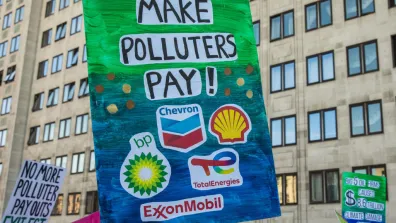
But the impact of intensifying climate breakdown on food production is only one part of the story. At the heart of what’s wrong with our food system is corporate and financial power. If we want to transform the food system, we need to challenge who controls it – and who benefits from it.
Who pulls the strings?
Over recent decades, ownership and control of the food system have become increasingly concentrated in the hands of a small number of corporations. Today, just four companies – Syngenta, Bayer, BASF and Corteva Agriscience – control 56% of the global agricultural chemicals market and half of the commercial seed market. This gives them enormous influence over what farmers grow, what inputs they use and how food is produced.
That economic power translates into political power. Large corporations spend millions lobbying governments and can influence the rules that regulate their products.
At the same time, land, food and water are increasingly treated as financial assets by banks, investors and financial markets – things to invest in and profit from, and opportunities to speculate on when crises drive prices up, rather than resources that communities depend on.
Together, this corporate and financial power has helped lock us into three dangerous dependencies that are a threat to the food system.
Read about the inequalities at the heart of the UK-Morocco food supply chains
Read the briefing!1. We’ve built a food system that runs on fossil fuels
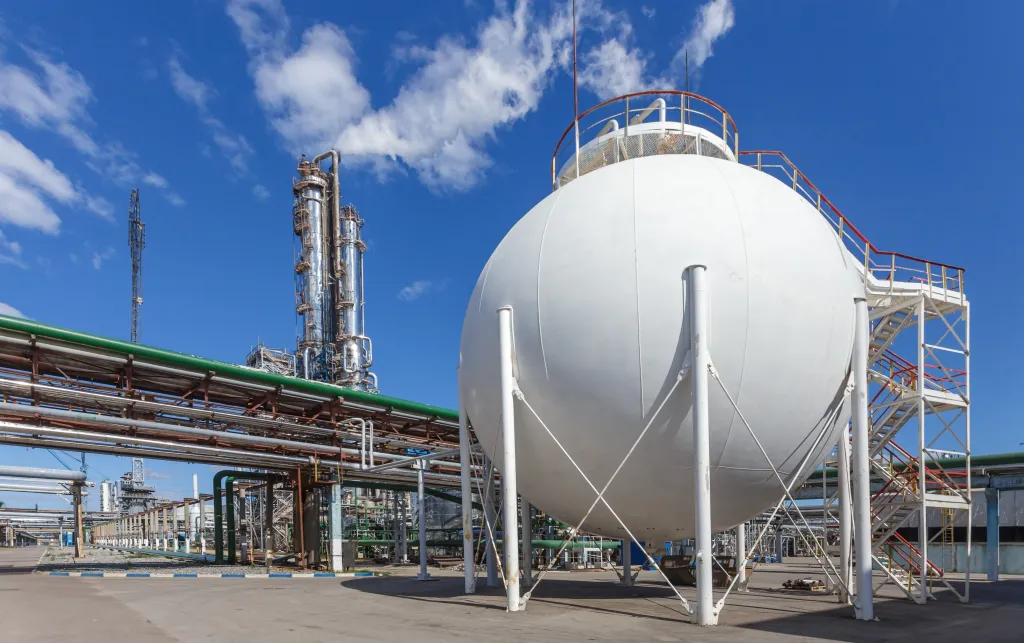
Fertilisers might not be the first thing we associate with fossil fuels, but synthetic fertilisers– used to grow food – are deeply dependent on them.
Nitrogen fertiliser is made using fossil gas, while phosphorus and potassium come from mining finite mineral deposits. Production, exports and sales of these key fertilisers are concentrated in a relatively small number of countries and corporations, giving them significant power over the resources farmers depend on.
The dependency on fossil fuels goes beyond fertiliser. Fossil fuels power tractors, irrigation, processing and transport across the food system, with industrial food systems estimated to consume at least 15% of fossil fuels globally.
We’re already seeing the consequences. The ongoing crisis in the Strait of Hormuz has disrupted global fertiliser supplies and driven up prices, showing how quickly geopolitical crises can ripple through the food system.
And the costs of this dependency are often felt by people living where those resources are extracted. In Gabès, Tunisia, decades of phosphate processing have polluted air and water, damaged farmland and ecosystems, and contributed to serious public health concerns – while the industry continues to serve global markets.
2. Small farmers have been made dependent on corporate seeds and pesticides
For centuries, farmers bred, selected, exchanged and saved seeds suited to their land, climate and needs. But over the 20th century, commercial seed corporations increasingly changed that, promoting hybrid seed varieties alongside chemical pesticides to manage pests and diseases as part of a single ‘package’.
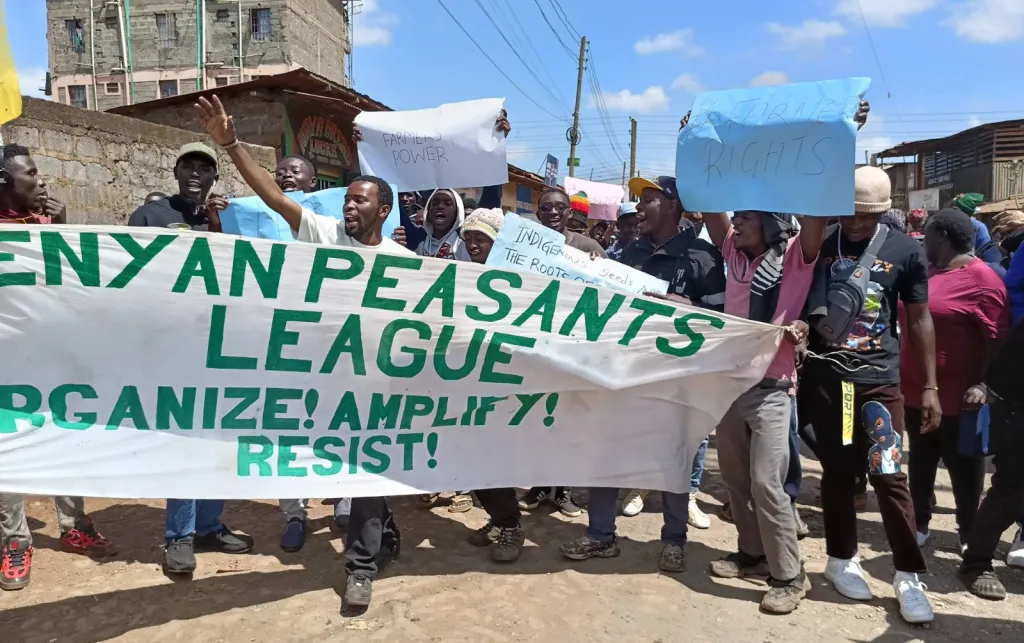
The resulting consequences for our current food system have been severe. As our partner the Kenyan Peasants League (KPL) put it, “Indigenous and farmer-managed seeds are often more resilient to local climate shocks, pests, and diseases than uniform commercial varieties.”
As farmers become more reliant on commercial seeds and pesticides, they have less control over the way they farm and can become locked into buying inputs from large corporations. The costs aren't just financial. Pesticides have a devastating effect on people’s health. More than 385 million unintentional pesticide poisonings occur every year. Chronic exposure has been firmly linked to increased risks of cancer, reproductive disorders and neurological disease. They also drive biodiversity loss, undermining the ecosystems food production depends on – from pollination and natural pest control to healthy soils.
And these harms are not shared equally. Across the Global South, communities are increasingly left to bear the costs of industrial agriculture and extraction in what are known as ‘sacrifice zones’ – while the benefits are captured elsewhere.
This corporate-controlled seed system is reinforced by other things too. Public subsidies for corporations, research programmes and trade rules can favour commercial seed corporations and large agribusinesses. Smalll farmers and Indigenous communities are increasingly pushed aside, with their knowledge and seed systems undermined . In Kenya, for example, the adoption of UPOV91 convention on plant variety protection has contributed to the criminalisation of informal seed systems, making it harder for farmers to breed, save and exchange their own seeds.
"We have seen cases where farmers who depend on purchased seeds have failed to cultivate their farms due to rising seed prices, or have opted to spray their farms to avoid hard labour." – the Kenyan Peasants League
Small farmers are left caught in a system where the choices available to them are increasingly shaped by the companies selling the inputs they depend on.
3. Trade rules are trapping Global South countries in debt
Across much of the Global South, farmers are pushed to grow crops to sell overseas instead of food to feed their own communities. Meanwhile, cheap food imported from abroad can make it harder for local farmers to earn a living. As local food production suffers, countries become more dependent on imports.
This can create a vicious circle. Countries need money from exports to pay off debts and buy food. But if the price of the crops they sell suddenly drops, they earn less while still facing the same bills. To make ends meet, they’re pushed to keep growing crops for export, leaving less room to grow food for their own people
The people producing our food feel the consequences the most. In Morocco, the growing export trade in tomatoes and berries has created a system where workers face poverty wages and unsafe conditions, while large farms and buyers capture more of the value. In Sri Lanka’s tea sector, multinational buyers have increasingly shifted costs and risks onto small farmers, who must produce large volumes at low prices.
Trade rules can reinforce these inequalities too. Under Investor-State Dispute Settlement (ISDS), corporations can sue governments over policies that harm their investments. This can make governments more cautious about introducing rules that protect people and the environment.
The result is a food system shaped around exports and corporate profits, rather than the needs of the people who grow and eat our food.
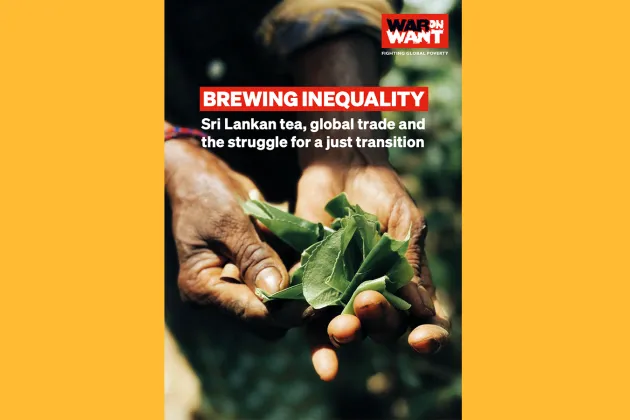
From Sri Lankan tea plantations to UK supermarkets, explore how global trade drives inequality.
Read the briefing!Building a food system that works for people and planet
A better food system is possible. Agroecology – farming that works with nature, supports farmers and workers, and protects biodiversity – offers an alternative to industrial agriculture. Across the world, farmers and Indigenous movements are protecting diverse seeds and sharing knowledge that helps communities grow food and adapt to climate impacts.
In Sri Lanka, War on Want partner MONLAR is working with farmers, civil society and government institutions on a national plan for an agroecological transition. It also supports cooperatives that help farmers process, distribute and sell their produce, keeping more value in their communities and making nutritious food more accessible.
But these alternatives won’t flourish on their own. Governments must stop funding harmful subsidies for corporations and fossil fuels and shift funding towards agroecology and small-scale farming, investing in training, research, access to land and water, and affordable alternatives to chemical inputs.Communities in the Global South need support to deal with the impacts of the climate crisis, without their countries being pushed further into debt.
We must also challenge the corporate and financial power that concentrates control over seeds, inputs and supply chains, and treats food as a source of profit. Corporate narratives that present industrial agriculture as the only way to feed the world help sideline alternatives and keep farmers dependent.
Building a food system that works for people and planet means funding the alternatives already taking root – and challenging the power that stands in their way.
Share this page
Read next
Who pays the price of extraction?
What is Investor-State Dispute Settlement (ISDS)?